Construction History - 11/14/01
| Home | October 2, 2001 | November 14, 2001 | January 15, 2002 |
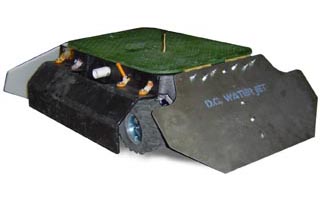
IRRIGATOR
Construction History - 11/14/01| Home | October 2, 2001 | November 14, 2001 | January 15, 2002 | |
IRRIGATOR |
November 14, 2001 - Current weight: ~50 pounds.
Click the pictures to enlarge.
 I purchased the chassis made of cutting board material, high density polyethylene (HDPE). The chassis is much smaller than the earlier version so that components could fit inside the irrigation box. Its a tight fit, especially around the batteries and the gear boxes.
 Front view. Even squeezing the (2) 1/4 scale servos into the space was tough.
 The vehicle looks pretty low profile in this picture, but with the flipping mechanism, it gets pretty tall. The vertical steel pipe (under the steel tee fitting) will take the brunt of head on collisions forces. Hopefully it will be strong enough and not break off from the chassis.
 Top view. For people familiar with the Traxxas EMAXX, you will notice that the motors are mounted backwards in this picture. The design drawing below (the close-up with cover off, and plan view drawing) shows the motors (blue) mounted in the original EMAXX configuration. Damn motors fit ok in the design drawing, but I guess I didn't account for solder tabs and wires sticking out the back of the motor. During assembly, the motors and wires didn't clear the batteries. After a 1 hour brainstorm/experiment session, I came up with this solution which consisted of using a second motor mount plate (motor plates shown in blue here), 4 aluminum spacers, and mounting the motor on the opposite side of the gear box as shown here. It seems to work very well, and actually has nice advantages. This configuration will help protect the exposed pinion and spur gears since they are now sandwiched between the 2 motor mount plates. Because the motor mounts are slotted to allows for gear mesh adjustments for various size gears, gear mesh normally needs to be set everytime a motor is removed. By using this configuration, I can remove the front plate with the motors still bolted to it, so now I won't have to adjust gear mesh everytime I want to remove the motors. Also, there is now more room in the area where I want to mount the speed controller. This is one of those "it was meant to be" solutions.
 This is how the cover fit over the chassis. The design drawing played a big role in what you see here. Used it to size and shape the chassis and position the bulkheads for proper wheel placement. It helped to show how the chassis and cover needed to be cut to allow enough clearance for the tires. And most importantly, the drawing helped insure that the components could actually fit inside the confined space. It showed me that batteries needed to be mounted upright, the tranny mounts for the EMAXX tranny needed to be modified and shortened, and that clearance for the flipping mechanism's base plate between the batteries would be a major issue. Once I modified the parts to make things fit, I was excited when it all came together because it verified the match between the drawing to the real thing. Front 2 wheel wells have been cut out.
 Close-up of one of the wheel well cut outs. I ended up not having to cut out as much as what the design drawing showed.
 Cover and green lid on top. Still need to cut out a portion of the lid to allow for the flipping mechanism.
 Front view. Still need all the bumpers and wheel protection. The white extra part of the chassis sticking out will be cut back once I'm sure I don't need extra material in that area anymore.
 Flipper arm gearbox shown in the center of the vehicle. The gearbox is a gearbox for one of those motorized kiddy cars that run off a car battery. I got the gearboxes from American Surplus. The flipping mechanism uses 2 of those gearboxes as shown in the picture.
 Isometric view. 3/4" PVC pipe bumper/wheel protection shown in white. Flipping arm, also made of 3/4" PVC is shown in yellow. If I'm ever flipped upside-down, the kiddy gearbox will turn the yellow arm like a jump rope and is intended to flip my vehicle back on its wheels. It may also be useful for offensive purposes to flip opponents.
 Profile.
 Close-up of the insides without the cover. Notice the 4 drive motors in the drawing still reflect the original mounting position which ended up being too close to the batteries.
 Plan view.
 DOWNLOAD YOUR OWN IRRIGATOR DESKTOP TODAY